
Bitcoin's August Squeeze: What Changed Hands

On Wednesday 19 August the US Treasury said it would at least double its long-end buybacks, to at least $4 billion per operation from 9 September, propping up a stretch of the curve that had gone without buyers since late June.
By Friday those bonds had returned 0.01% on the week. Gold returned 5.45%. Bitcoin returned 23.78%. The S&P 500 lost 1.37%.
An intervention that moves everything except the thing it was aimed at is not a policy success. The same Treasury print that carried the buyback announcement also showed the national debt crossing $40 trillion. Basically, the market bought the assets that sit outside the fiscal system and sold the ones priced off it. The 30-year finished roughly where it started, having touched 5.3% along the way its highest since 2007.
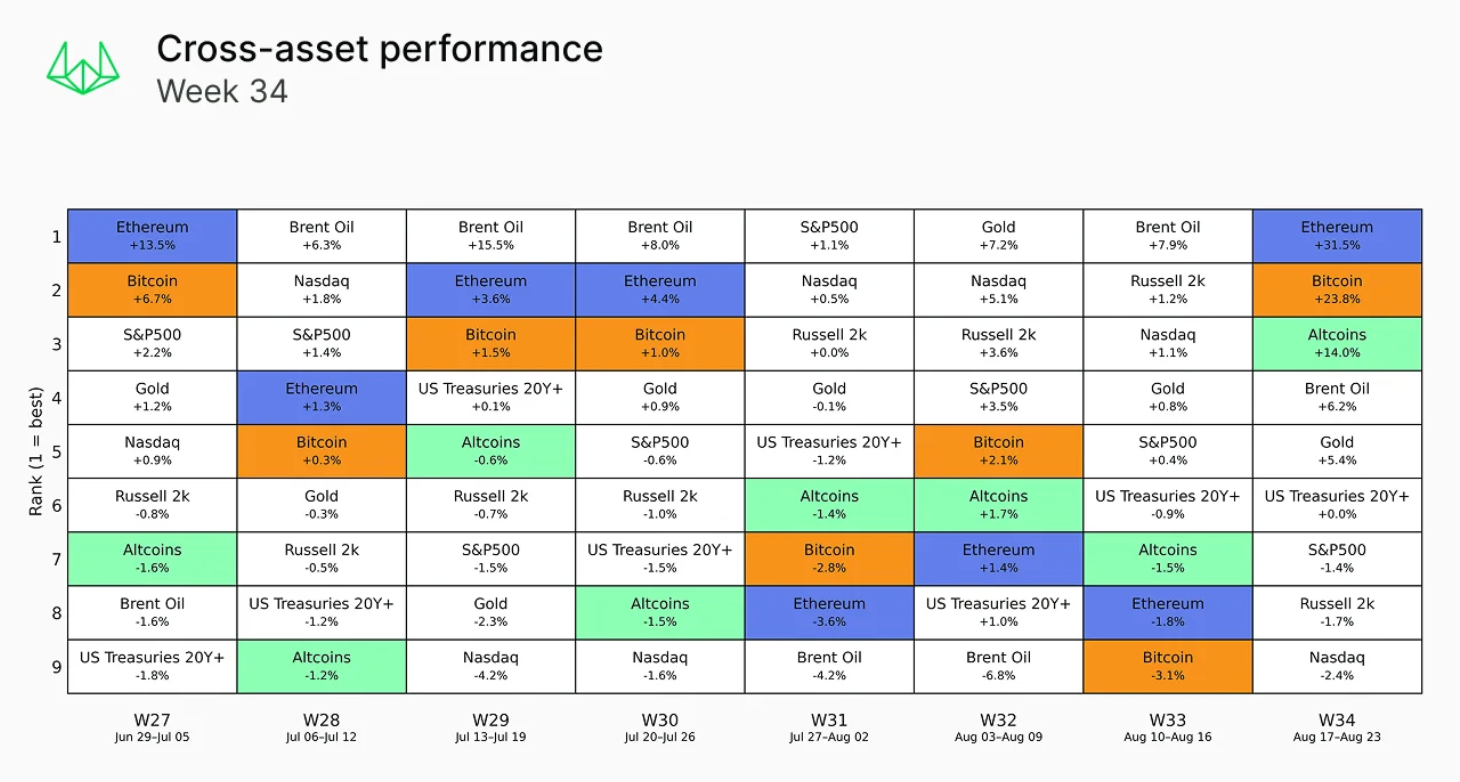
That is the backdrop. A week on the move has held: price sits near $78,300, having tagged $80,000 and given back little of the run from $64,000.
What 19 August cleared
The rally was ignited by the largest single day of short liquidations on record since 2019, and across the squeeze roughly 85–92% of everything liquidated was short-side a record $2.7 billion between $63,000 and $79,000. In plain terms, a large share of the buying that lifted Bitcoin came from people who did not want to buy it.
That is usually where a bullish read collapses, forced buyers finish and the bids eventually die.
Except the leverage did not come back this time. Futures open interest shrank 11% in coin terms across the move, liquidated shorts were not replaced with new contracts. Funding barely left its neutral baseline and printed negative hours afterwards, so nobody chased. And the move consumed 86% of the modelled liquidation fuel sitting in its path.
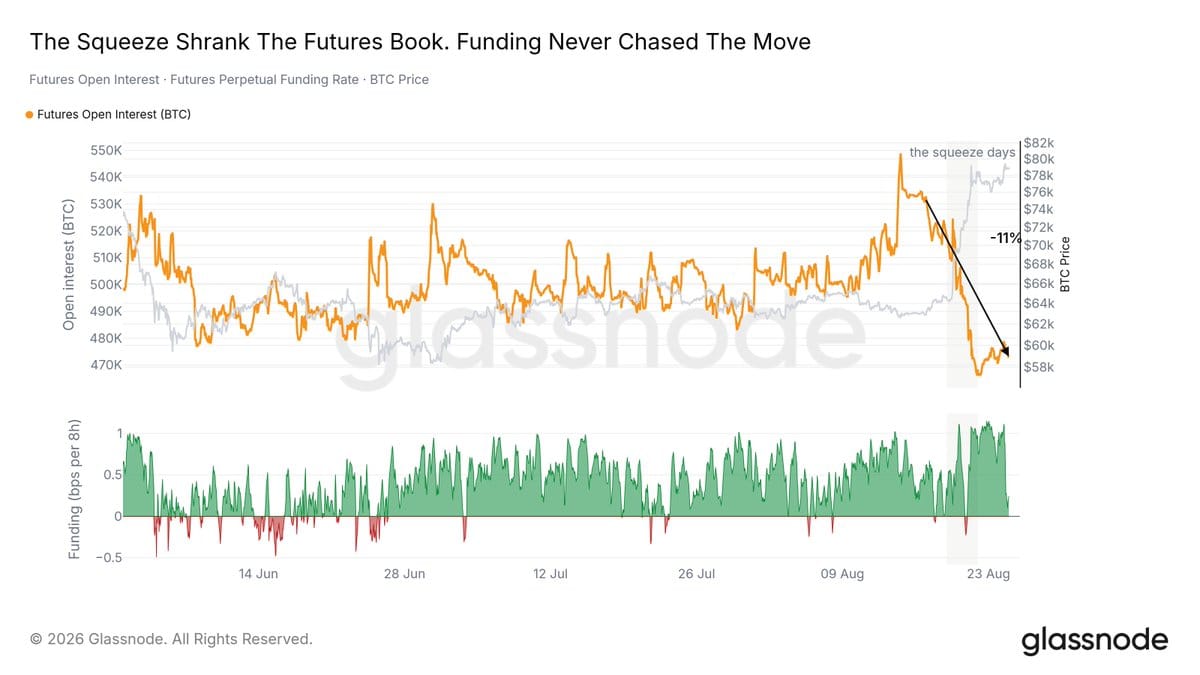
A squeeze that ends with less leverage in the system than it began with is not a coiled spring waiting to unwind. It is a market that has been cleaned out. The distinction matters more than the headline: the same $2.7 billion figure that makes this look fragile is what makes the base underneath it solid.
Basis tells the same story from the professional side. Three-month annualised basis pushed toward 5% from 2–3% in late July, which now clears the 10-year Treasury and restores the cash-and-carry trade that had been dead all summer. That is not speculative leverage returning. It is arbitrage capital finding a spread worth taking, which is what a functioning market looks like.
What was underneath
With the leverage out of the way, the ownership base became visible, and it had been changing quietly for months.
Spot ETFs absorbed $2.23 billion across the squeeze window without a single outflow day, the strongest seven-day intake of the year, its best day the largest creation since January. On a calendar-week basis the figure was $1.92 billion, with IBIT taking $1.33 billion of it.
More telling than the total is where the coins went. Since the 30 June low, wallets holding 1,000–10,000 BTC have shed 50,500 coins. The band above 100,000 BTC — exchanges, custodians and ETF wrappers absorbed 59,100.
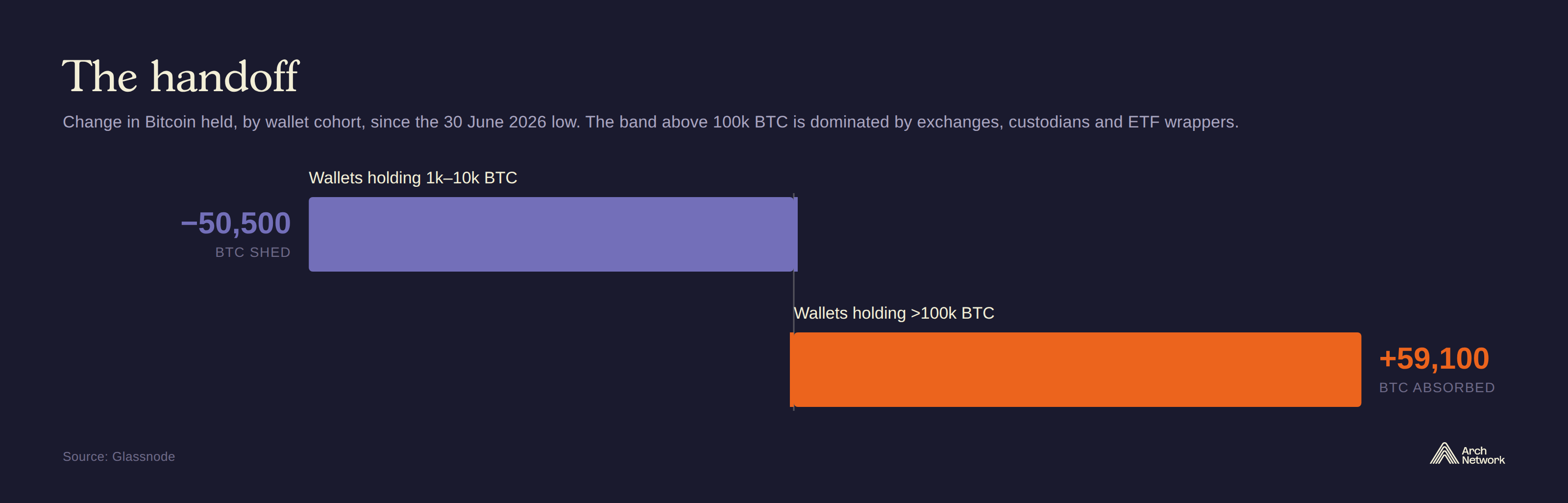
Those two numbers describe a transfer, not a rally. Mid-sized holders sold into strength and institutional custody took the other side at roughly the same scale. This is the second consecutive quarter it has happened: through a Q2 in which price fell 14.2%, institutional ETF positions rose while the number of filers holding them fell. Fewer owners, larger positions, on better rails.
And it was not narrow. All six wallet-size cohorts have been accumulating since 5 August — a twenty-day stretch, the most persistent all-cohort accumulation since late 2024. Retail and whales moving in the same direction for three straight weeks is rare enough to be worth noting on its own.
The infrastructure moved to meet the demand. This morning BlackRock cut the minimum for converting Bitcoin directly into IBIT from $25 million to $1 million, with in-kind conversions already past $5 billion. Read that as a plumbing change and it is trivial. Read it as a statement about expected volume and it is not: you do not widen a pipe by a factor of twenty-five for traffic you are not expecting.
Why the rotation reversed
For most of 2026 the explanation for Bitcoin's absence was that artificial intelligence had absorbed all available risk appetite. It was a good explanation, and BlackRock's own digital assets head reached for it in June, describing AI momentum as sucking the oxygen out of the room.
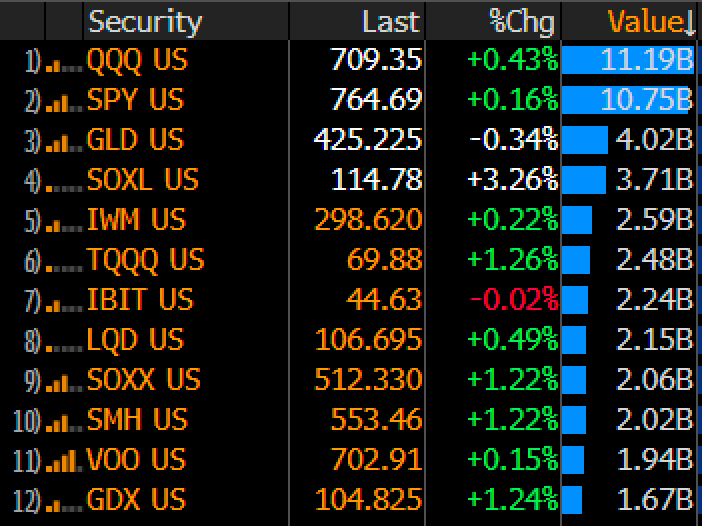
That has now measurably changed. GLD and IBIT were back among the ten most-traded ETFs in the US, displacing the semiconductor funds that owned the list all summer. Money is not merely leaving AI trades; it is arriving in the two assets people buy when they doubt the currency.
The correlation data closes the argument. Across the squeeze window Bitcoin gained 25% while the S&P 500 slipped 1.7%, and the rolling one-month return correlation between them collapsed toward zero. Whatever drove this move, it was not equity beta you cannot ride a market that is falling. Twice in 2025 similar fast-window breaks mean-reverted within weeks, so this is not yet a structural divorce. But for one week, Bitcoin traded as the thing it is supposed to be rather than as a high-multiple tech proxy.
What could take it back
Two risks sit outside anything an on-chain feed can see, and both got worse this week.
The Fed is not very cooperating. Its 9–3 hold produced the first triple-hawkish dissent since September 2016, with many participants viewing further tightening as likely if inflation fails to decline and two non-voters indicating they would have backed a hike outright. A market that just rallied on a liquidity headline is positioned against that, and Warsh has stripped forward guidance from every statement since taking the chair which makes his Jackson Hole appearance on 28 August the rare venue where saying nothing is itself a message.
Then there is oil. Only two tankers crossed the Strait of Hormuz on 25 August, and the Strategic Petroleum Reserve fell another 3.7 million barrels to 289.7 million already 10.3 million below its stress-zone threshold. A renewed disruption would arrive with unusually little cushion behind it, and it would land in the same inflation prints Warsh has to answer for. Brent was up 6.24% on the week, which on the debasement board looks like confirmation and in the CPI series looks like a problem.
That is the honest tension in the macro case. The fiscal argument for holding Bitcoin and the inflation path that keeps the Fed hawkish are the same argument seen from two ends.
The problem nobody has solved
What the wreckage exposes is that the underlying gap never closed.
Of roughly 20 million Bitcoin, about 311,000 earn anything at all. That is 1.5%, against roughly 35% of Ethereum staked. The entire Bitcoin-DeFi ecosystem sits under half a percent of supply.
The comfortable reading is that Bitcoin holders simply do not want yield. August argues otherwise. Those same holders moved $2.23 billion into regulated wrappers in seven days, and 59,100 coins onto custodial rails since June. This is not a population that refuses counterparty risk. It is a population that is precise about which counterparty, and every yield product of the last decade asked them to wrap the coin, bridge it, or trust an organisation they had never heard of.
That is a plumbing problem, not a preference problem, and it is the one Arch is built to address: execution against native Bitcoin UTXOs rather than a wrapped claim on them.
Where this gets tested
Everything above is description. The forecasts belong to the people who publish them, and three of them have converged on the same number from different directions.
- Glassnode puts the confirmation level at a settled close above $83,300 with ETF intake holding, against a stack of overhead supply,cost-basis shelves, re-laddered asks, a dealer gamma flip at $82,300, clustered between $81,000 and $86,000.
- CryptoQuant needs a close above its 365-day moving average near $83,000, with its Bull Score having gone from 30 to 80 in a week.
- Wintermute turned constructive but published its reversal condition: a negative ETF flow week alongside a close back under $67,000 would say the advance was leverage after all.
- Bitfinex puts the first real test at $85,000 the largest cluster of overhead supply, and the level where holders who bought higher can finally exit at breakeven. In their framing it is the first price at which demand has to outweigh genuine selling rather than momentum.
Four firms have shared three methodologies but one number.
The leverage went, and some of it has come back. The buyers left behind are larger, slower and better custodied than the ones who left, and a week on they are still buying while everyone else goes quiet. Whether that is enough to clear $83,000–$85,000 is a question the next few weeks answer. The honest position today is that the base is better than it was in June, the ceiling is closer than it looks, and the market has quietly re-armed the same short-side structure that lit the last move.
Interested in the future of Bitcoin Finance?
Check out our docs: https://docs.arch.network/