
The Full-Stack Onchain Bank

Crypto gave everyone the tools to grow their money. For the first time, anyone with a wallet could earn yield, borrow against what they hold, trade around the clock and lever their yield, with no bank or institution deciding whether their money is good enough. People used those tools to build savings, reach opportunities that were never offered to them, and grow real portfolios.
But there has always been one glaring issue. It cannot scale.
You earn on one platform, borrow on another, and trade on a third, and none of them can see what you're doing on the others. Your money earns in one place and sits idle in another. Every move between them costs time and fees, and keeping track of it all becomes half the work.
Instead of your money working for you, you end up working for it.
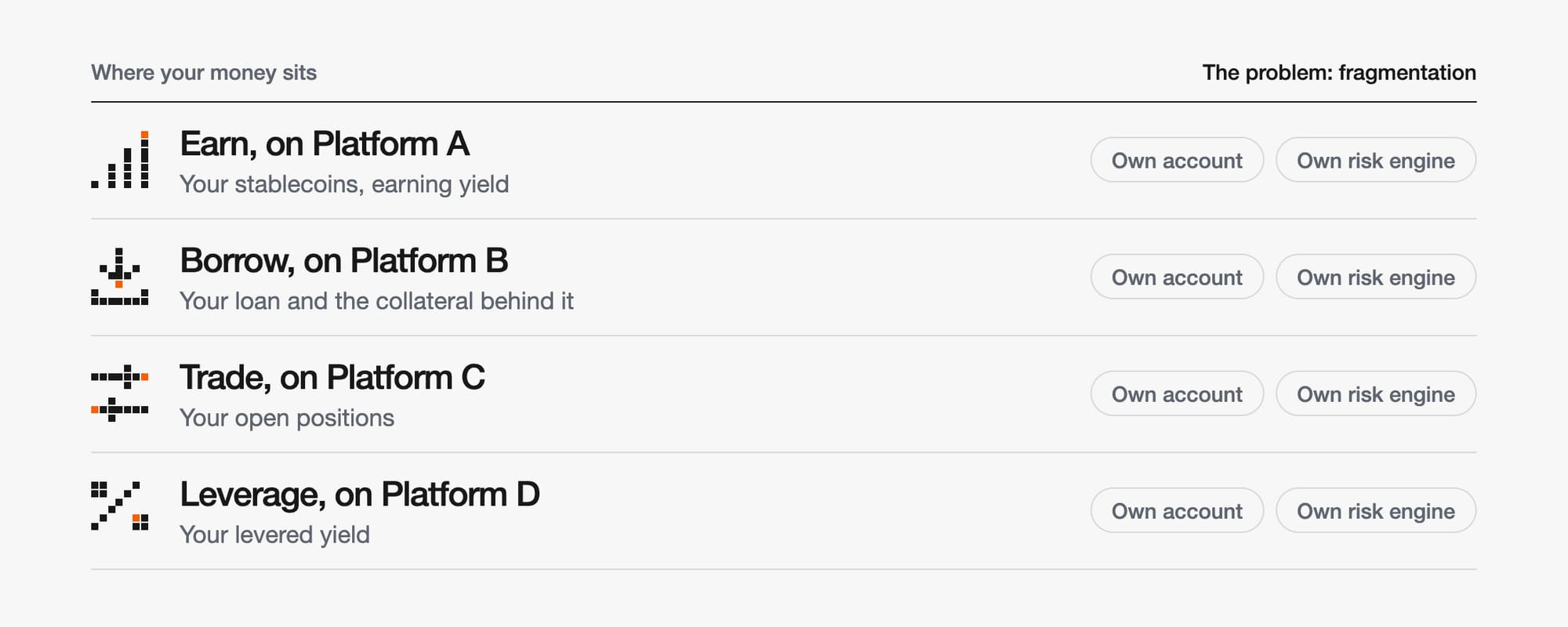
Every move between platforms costs time and fees. Keeping track of it all becomes half the work.On a good day this is menial labour, but on a black swan the cracks in the system open up and engulf the market. Each platform manages its own risk for its own customers, and none of them can see the rest of what you hold elsewhere. When prices fall, each platform aims to protect itself: it closes your positions one at a time, even when the rest of your portfolio could have covered them, and dumps the collateral into the same thin orderbooks.
Prices cascade, and the dominoes start to fall. On 10 October 2025, about $19 billion was liquidated in a single day from this exact mechanism.
Every protocol protects its own position. Nobody protects your portfolio.
Years of careful work can disappear in an afternoon. For most people, growing their money in crypto is still a fight.
The ceiling
This isn't just a problem for users. It's why onchain lending can't grow.
DeFi proved that finance can be open: anyone, anywhere, can lend and borrow without asking a bank for permission. But all of crypto's lending today is about $56 billion. US commercial banks alone lend about $13.3 trillion, so crypto is roughly 0.4% of that. And instead of compounding the way credit does in traditional finance, onchain credit grows in every bull market and shrinks back in every downturn. DeFi lending has roughly halved from its peak in under a year.
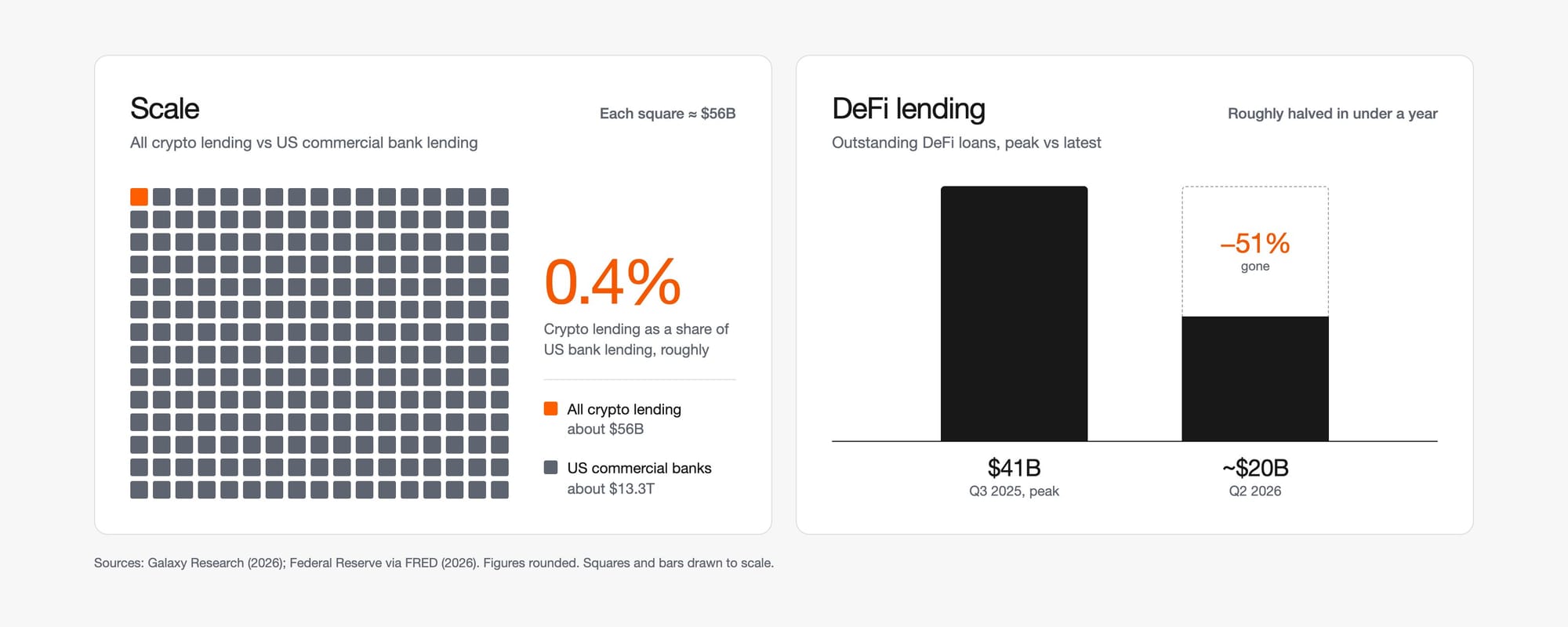
The reason is simple - overdecentralization. Too much decentralization leads to fragmentation, and that's where cracks start to appear. Outside of less efficient yield due to continuously hopping between different protocols, every platform manages risk one position at a time. When a loan crosses its limit, it has to be closed in a single block, and the collateral is sold straight into whatever depth is onchain at that moment. That works while lending is small. But the more that's lent, the more has to be sold at once, and the less of it the market can absorb. If a market can take $100 million of selling and $5 million hits it in seconds, the price gaps down and the next account is pushed over its limit.
DeFi stays safe by staying small.
The insight
This world is not one able to house global capital markets. There is a ceiling, but it can be raised.
By creating a unified risk perimeter.
Decentralize custody. Professionalize risk.
At Arch, we believe that crypto already has the tools. What nobody has done is bring them together, and we realised that if you build that in the right way, you unlock far more than convenience. Build one self-custody account on one risk perimeter, and we can let every asset you hold count towards what you can borrow, so nothing sits idle, and your money earns more. We can give you better execution and manage your risk as a whole, protecting you on the way down instead of closing you out one platform at a time.
Doing that safely, at scale, means owning every piece of the risk: seeing every asset in one account, acting first when risk appears, having your own dollar to repay lenders, and a trading desk that can take risk on and unwind it carefully. Once you own all of that, what you can offer looks a lot like a bank. A Full-Stack Onchain Bank.
That's what traditional banks have always done. They put everything under one roof: one place where your money earns, where you can borrow and invest, and where someone manages the risk for you.The world's 1,000 largest banks collectively hold $164 trillion in total assets, and made $1.3 trillion in net income in 2025 doing it.Arch brings that same experience onchain: everything you need to grow your money, in one place.
The vision
We want to enable a tradfi experience while you stay in control of your assets. Credit against everything you own, so you can grow your money without selling it. You get the best rates and yield, while someone manages the risk, so a bad day doesn't undo a lifetime of work. Until now, everyone has been left to do it themselves. It's time to change that.
Everything you need to grow your money under one roof, with a risk engine that sees your whole portfolio. You work with the market instead of fighting it, and a bad day doesn't undo years of work. You stop fighting for your portfolio, and your portfolio starts fighting for you.
Arch Prime
Arch Prime works like a bank, built onchain. You earn on everything you hold, and it keeps counting towards what you can borrow. You borrow against your whole portfolio without selling. You trade from the same account.
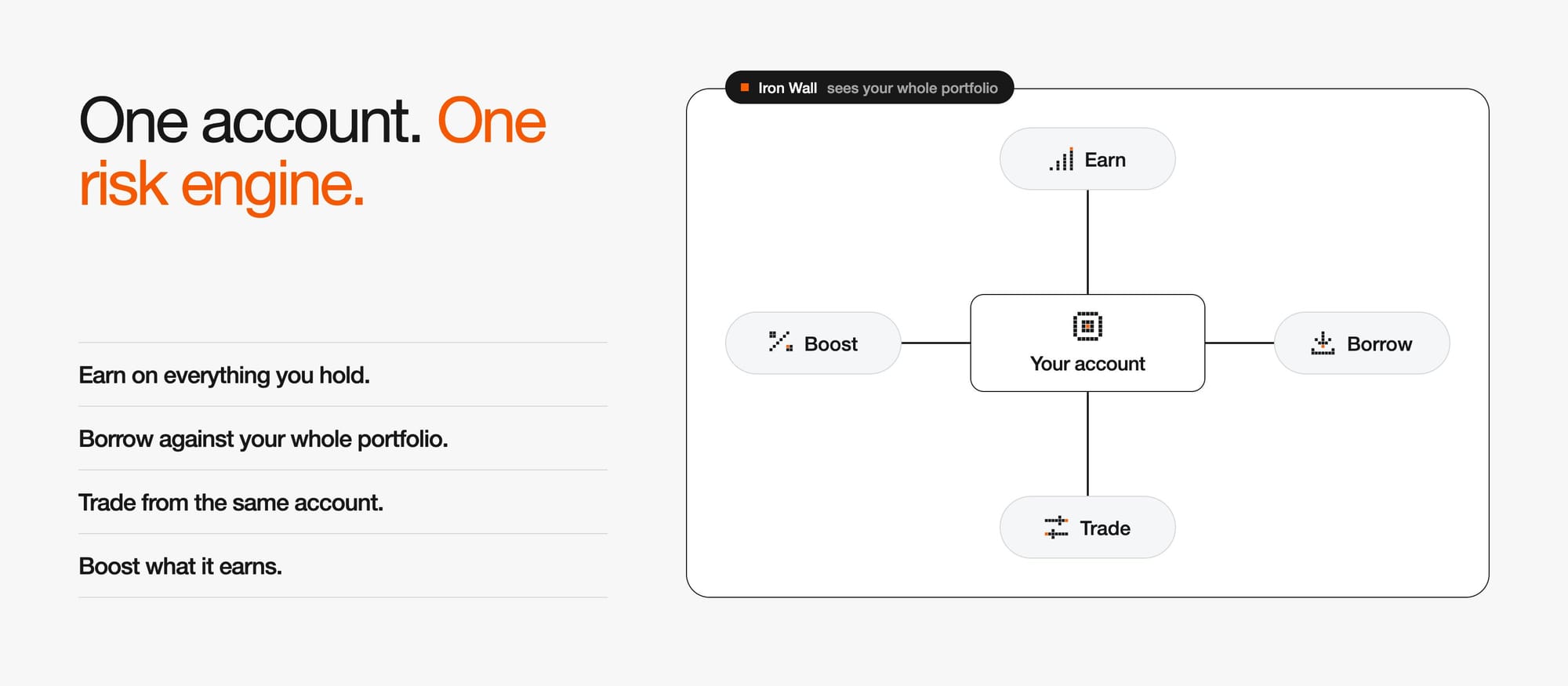
Because everything sits in one place, Arch can do something no single app can: run one risk engine across your whole portfolio. Our risk engine, Iron Wall, watches everything you hold, protects you when markets turn, and handles positions carefully, liquidating them across 60+ venues and repaying lenders in under 300ms, instead of dumping them into a falling market. It's built to hold steady when the market doesn't.And it stays yours.
There's no KYC, you stay in control of your assets, and your wallet signs every move.
How we built it
None of this works with pieces borrowed and stitched together from other platforms, so we spent two years building the whole stack, and acquired specific people and pieces to complete it. Each piece does a specific job.
Our own chain. Arch Prime runs on Arch's own chain, so everything in your account settles in one place, and risk always comes first: when a position needs attention, it never waits behind unrelated transactions. Every block keeps a reserved lane for those risk transactions, so they don't have to bid for space or sit in a queue while the market moves. Pricing a position, taking the collateral and settling the debt happen together in a single step, so the price can't drift halfway through and nobody can front-run it. Transactions are final in about 300 milliseconds. And when you post Bitcoin as collateral, it stays Bitcoin, at its own address, under spending rules the chain enforces, rather than being wrapped or bridged somewhere else.
Our own dollar. aUSD is the dollar the whole system runs on. Borrowing, repayments and closeouts all happen in one unit, so nothing has to be swapped or bridged at the worst possible moment. Every aUSD is backed one-for-one by USDC held with BitGo and Copper, and the reserves are published so anyone can check them. aUSD is only issued against dollars that have already arrived. That matters most on a bad day. When a position has to close, the collateral is sold, aUSD is issued against the proceeds, and lenders are repaid in the same dollar they lent, in under three seconds.
Our own trading desk. Some pieces we built. Others we went out and acquired, because the best teams had already built them. One of them is a professional trading desk that has run market-neutral strategies through multiple market cycles, across about 60 venues. It runs the strategies behind our yield and the desk behind Iron Wall, and when a position has to close, it handles it carefully across those venues instead of dumping it into one market.
More on that soon.
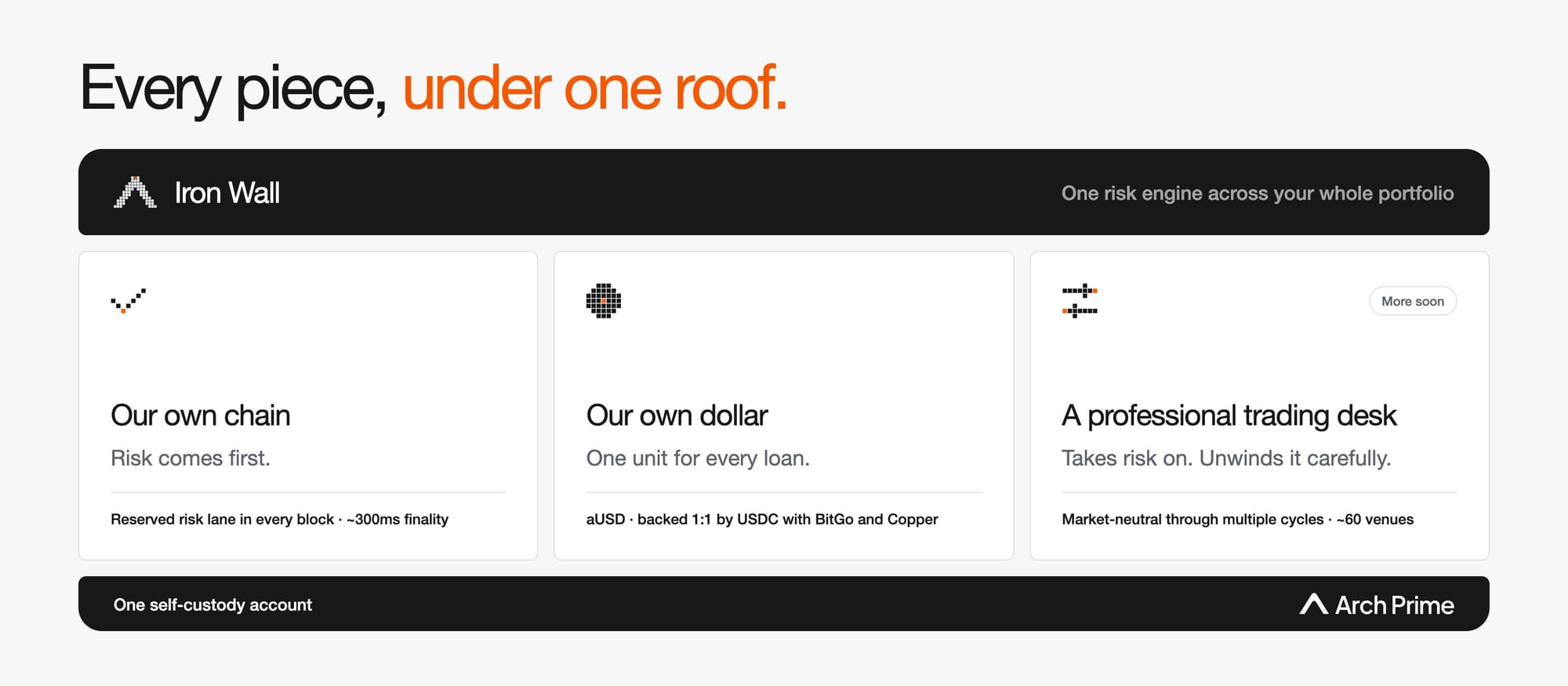
Each of these pieces exists somewhere in crypto on its own. What nobody else has is all of them working together, under one risk engine, in one account. That's what makes the outcomes in this piece possible: more yield, better execution, and protection when markets turn.
And we're not stopping at the crypto you trade. Soon, what you hold will be able to help with some of the biggest decisions in your life, in ways it never could before.
Where this goes
Arch Prime is where we start, not where we stop. Once risk is managed across a whole portfolio, the ceiling on onchain finance starts to lift, and much more becomes possible.
Your portfolio, in one place. That's Arch Prime: everything you need to grow your money, in one account, today.
The infrastructure we're building is what lets credit come onchain at scale. One risk perimeter, with a robust risk engine makes for far more sophisticated risk management than anything onchain today, so credit can grow DeFi can flourish.
We'll go deeper into how it works in our piece on Iron Wall, and we'll have more to announce soon. It matters because the data is clear: all of crypto's lending today is about $56 billion, and institutional capital in the hundreds of billions won't come onchain until the risk infrastructure can carry it. This is what lets it.
The same approach can extend to any asset that can be priced and hedged, well beyond crypto. That's DeFi 2.0: onchain finance strong enough to carry global capital.
The invitation
Our mission is to bring global finance onchain. Arch Prime is the first step.You've fought for your portfolio. Now let it fight for you.
Sign up to join our waitlist: https://app.arch.network/waitlist